Why Place Names Keep More Than One Story
Why place names keep more than one story: trace language layers, older spellings, and local use to read a name without forcing one tidy origin.
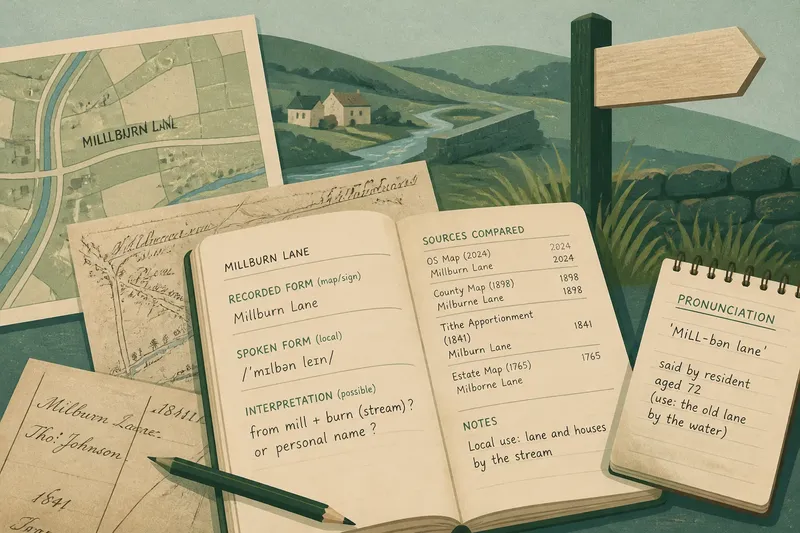
A name on a road sign may carry a different history from the name spoken at a nearby farm. Why place names keep more than one story becomes clear when you compare the label on a map with older spellings, local pronunciation, and the languages once used in the area. Treat each as evidence of a different moment, not as a vote for one definitive origin.
Place-name field notes work best when they stay small and specific. Choose a single village, hill, stream, or crossing; record what you can actually observe; then separate observation from interpretation. That keeps an appealing story from turning into an unsupported etymology.
A name can belong to several layers of use
Place names often pass through more than one language. A community may name a feature, another group may adapt the sound to its own speech, and a later authority may settle on a spelling for maps or administration. The resulting form can preserve traces of several stages without neatly revealing each one.
Consider a stream whose current name resembles a word in the language spoken locally today. An older map might show a different spelling, while a neighboring place name contains a form associated with an earlier language. Those details suggest questions to investigate; by themselves, they do not prove the stream’s original name or the meaning intended by its first users.
Keep three observations distinct in your notes:
- Recorded form: Copy the spelling, capitalization, and any accent marks exactly as they appear on a sign or map.
- Spoken form: Note how local speakers pronounce the name, including sounds that a standard spelling may conceal.
- Interpretation: Mark proposed meanings or language connections as possibilities unless a reliable source establishes them.
This separation is like keeping different keys on one ring: they belong together, but each opens a different door. A map spelling identifies a conventional label; a spoken form records use; an etymology makes a claim about history.
Older spellings are clues, not translations
Historical maps, parish records, land documents, and gazetteers can reveal that a place name changed shape. They may show a sound being represented in several ways, a word being shortened, or a familiar spelling appearing only after a new mapping convention took hold. The sequence can help explain how today’s form emerged.
Do not read every old spelling as a direct translation. A clerk might have written an unfamiliar sound using the conventions of another language. A mapmaker might have copied a name from an earlier map, while a local record might reflect a different pronunciation. Even when two forms resemble each other, the resemblance needs context.
When comparing records, write down the source and the date shown on it, along with the exact form. Check whether the record refers to the same feature: a name may shift from a settlement to a nearby estate, road, or watercourse. Similar-looking names can also refer to separate places.
Look for patterns around the name. If several nearby names share a sound or ending, that cluster may offer a stronger linguistic lead than a single isolated resemblance. It still does not settle the meaning, but it gives you a sensible question to take to a local history collection or place-name reference work.
Pronunciation can preserve details a sign does not
Local speech may preserve a stress pattern, vowel, or consonant that the official spelling makes hard to hear. It may also reveal that residents use a shortened form or apply the name to a smaller area than the map label suggests. Those differences matter because names are used in conversation, not only printed on maps.
If you ask someone about a name, ask them to say it naturally and, if appropriate, to explain where they would use it. Avoid prompting them with a proposed origin before you listen. A leading question can turn an uncertain local explanation into an apparent confirmation.
Record the answer with care. Note who supplied it only when they are comfortable being identified, and distinguish a personal family account from a broadly shared local form. One person’s pronunciation is valuable evidence of use, but it does not automatically represent every household or generation.
Say you are looking into a lane called Millburn, and a resident pronounces it with a stress unlike the one you expected. You note the sound without proposing a meaning, then find an older map that spells the lane differently. The useful result is a documented contrast to investigate, not an instant conclusion that the name must refer to a mill or a stream.
Official labels and local names answer different needs
A standardized name helps people identify a place across maps, directories, emergency services, and public records. A local name may instead describe a familiar bend in a road, a field boundary, a former landing place, or a cluster of homes that has no separate official label. Both can be accurate within their own context.
For field notes, record where each form appears. A road sign, a current map, a building directory, and ordinary conversation are different settings. If a name occurs only in local speech, write that clearly rather than silently replacing the mapped label; if a formal label differs from what people say, preserve both.
Names can also change their reach. A name once applied to a farm or estate may later identify a neighborhood, while a nearby feature adopts a related form. A map’s placement of a label is not always a precise boundary, so use surrounding roads, buildings, and land features to clarify what the name refers to.
For official spelling and use, local rules and the relevant mapping or place-naming authority matter. For the history behind a form, consult records that explain their evidence and distinguish documented forms from proposed interpretations.
What should you check before accepting an origin story?
Does the proposed meaning fit the older forms?
Compare the suggested meaning with the earliest forms you can locate, rather than judging by how the modern spelling sounds. If the explanation requires several unexplained changes, record it as a possibility rather than a settled account.
Is the same name used for the same feature?
Check whether each source means the village, a nearby stream, a property, or a route. Similar names can move between neighboring features, and that shift can confuse a tidy explanation.
Do nearby names support the language connection?
Look for related forms in the surrounding area and note whether the proposed language is plausible for the region’s documented naming layers. A single resemblance is weaker evidence than a pattern, though a pattern still needs careful interpretation.
Who uses the explanation, and what evidence do they give?
Separate a local oral account, a family tradition, a popular guidebook claim, and a specialist explanation with cited forms. Each can be worth recording, but they do not carry the same kind of evidence.
Keep uncertainty visible in the finished note
A useful place-name note does not need to solve the name. It can state the current form, a locally heard pronunciation, the older spellings consulted, and the points that remain unclear. That record gives a future reader something firmer than a confident story with no trail back to its sources.
Use plain wording that marks confidence honestly: “recorded as,” “locally pronounced,” “possibly related to,” or “the origin remains uncertain.” Avoid turning a plausible resemblance into a fact by removing those qualifiers during editing. If a source offers competing explanations, note the alternatives and what evidence each relies on.
One compact entry might include the feature’s location, present spelling, source and date for each earlier form, pronunciation notes, and a brief comment on competing interpretations. Keep personal recollections attributed only with permission, and do not treat a spelling difference as evidence that one community’s name is less legitimate.
Why place names keep more than one story is not a puzzle with a required single answer. A careful note can show how language, local speech, mapping, and changing use meet in one label, while leaving open what the surviving evidence cannot settle. That restraint makes the name—and the people who continue to use it—easier to understand.